on
Speed Is THE Primary Business Strategy
Ivan’s note: I often come back to this presentation. I can’t find it online, so I wanted to have a copy here to share with people. It is adapted from a talk Mike Cassidy gave on October 23, 2010.
Why speed matters
The faster you can roll out a product, the harder it is for competitors to keep up with you.
One example is my third company, Xfire. It was an instant messenger for PC video gamers, and we released a new version of the product every two weeks. There were major competitors in instant messaging, including AOL. AOL identified us as a competitor and started designing a response to our product. But at a large company, the process of identifying a threat and defining the product to compete with it took approximately 12 months. By then, we already had 24 releases. Their plan for counteracting us was not going to work.
The second advantage is team morale. I’m a huge believer in the importance of morale. Whenever I have a one-on-one with someone in my company, the first thing I ask is, “Are you happy?” I think happy people are literally ten times more productive than people who aren’t happy. If your company is moving quickly, people tend to be happy and excited about its pace and prospects.
Third, speed is great from a PR perspective. You can meet with someone from the press and say, “We have two million users,” and they can respond, “I just met with you two months ago, and you only had one million.” The press loves that kind of momentum.
Finally, fast growth drives higher valuations—both when you raise money and when you sell the company. I believe that, to maximize value, you should sell while the company is still growing exponentially. Exponential growth is exciting because of what the future might hold. Once growth becomes linear, it’s easy for an acquirer or investor to project exactly where the company will be in two years.
The typical startup and the rapid startup
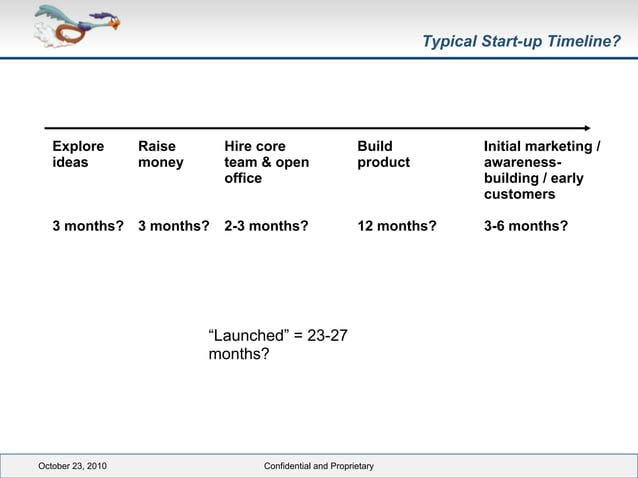
Let’s contrast a typical startup timeline with a rapid one. These numbers may be too slow to be typical anymore, but consider a company that spends three months kicking around ideas, three months raising money, two months hiring the core team and opening an office, 12 months building a good product, and another three to six months building initial market awareness and attracting early customers. The whole process takes 23 to 27 months.
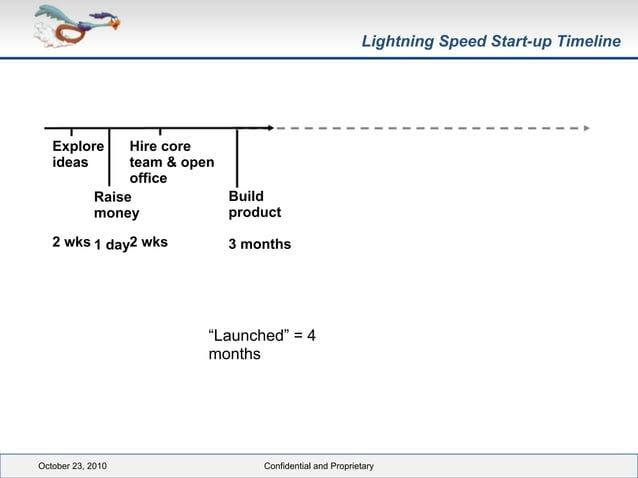
All four of my companies have been quite different, but this is the timeline I aim for.
Exploring ideas is a two-week process. I honestly believe you shouldn’t spend longer than that, because you’ll just find reasons not to do it: another company is already doing it, the risks are too great, and so on.
I put one day for raising money. Sometimes when I give this talk, people throw things at me. This is aspirational, and I’ve been very fortunate. I’ve raised eight rounds of venture capital, and in seven of those eight rounds I received a signed term sheet on the day I pitched. I’ll explain how you can try to raise money the same day you pitch.
Then comes hiring the core team and opening the office. Execution is where it’s at, and we’ll talk about how we handled those steps.
Finally, there’s building the product. At all of my companies, the successful product was built in three months. That was intentional. You don’t assemble the engineering team and ask, “How long will it take?” You say, “What can we build in three months?” This results in a company launching roughly four months after it starts.
Four examples
Many people aren’t familiar with all the companies I’ve built, so I’ll quickly walk through them.
Stylus Innovation
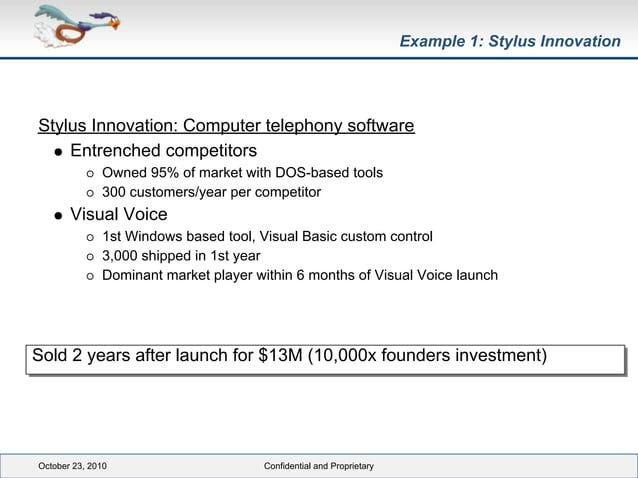
My first company was called Stylus Innovation, but its original name was Dial-a-Fish. Literally, Dial-a-Fish. It was going to change the way everyone ordered groceries in the United States. It turned into computer-telephony software.
When we started, entrenched competitors owned 95 percent of the market with DOS-based tools, and the typical competitor had about 300 customers. We built the first Windows-based tool and shipped 3,000 copies in our first year. We sold the company two years after launch for $13 million, which is tiny by Silicon Valley standards. The nice thing is that only $1,500 had been invested in it: I put in $500, and each of my two partners put in $500. I guess that made it a 10,000-times return on the founders’ investment.
As you’ll see, the original idea was a disaster at three of my four companies. Each had to change direction.
Dial-a-Fish was built before the internet. As you threw away a box of cereal, you would scan its barcode with a pen-sized wand. You’d then go to the telephone, where the barcode would be converted into touch tones and understood by a computer. The computer would know what you had thrown away and have it packaged and ready the next time you went to the store. This was before Webvan, too.
While building it, we discovered that all the tools for creating interactive voice-response applications—the applications that connected telephones and touch tones to computers—were terrible DOS-based products. So we built the first Windows-based one.
Direct Hit
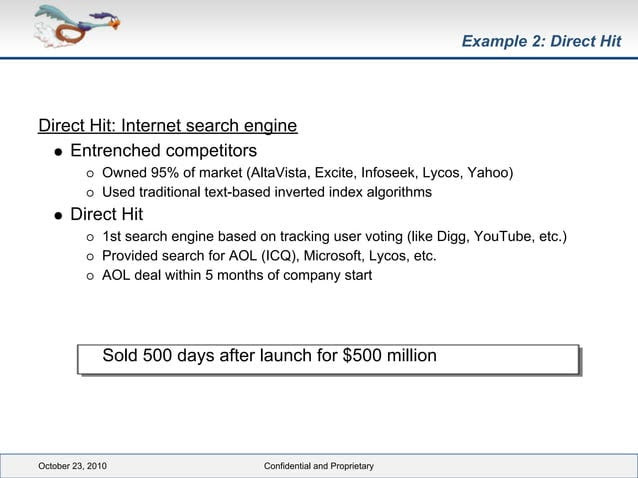
My second company, Direct Hit, was an internet search engine based on tracking which sites people clicked and how long they stayed. We launched it in 1998.
At the time, we appeared on the cover of The Industry Standard with Google. If someone spent five seconds at a site, we penalized it; if someone spent five minutes there, we rewarded it. We provided search results for AOL, Microsoft, and Lycos. We got the AOL deal within five months of starting the company. Five hundred days after launch, we sold Direct Hit for $500 million. That was a fair return, too.
Xfire
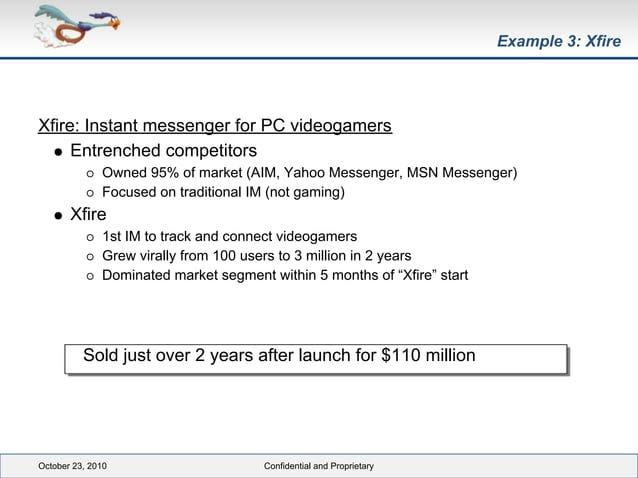
My third company, Xfire, was an instant messenger for PC video gamers. The beautiful thing about it was that it spread virally. In your IM client, you could see which online games your friends were playing—shooter games such as Doom and Quake. You could click a friend’s name and launch directly into the same game.
The product was completely useless unless your friends used it too, which meant that anyone who touched it had to recruit friends. It was extremely viral: on average, a user got five friends to start using it within the first three weeks. Xfire grew to three million users in two years, and we sold it to MTV for about $100 million.
The companies I’ve built have been in entirely different spaces: computer telephony, internet search, instant messaging for PC video gamers, and recommendations. I love entering new spaces. When someone says, “I’m not an expert in that space,” I think that’s great. People who are new to a field aren’t entrenched in all the ideas that lead longtime insiders to say, “You can never do that.”
It’s also fun for me because, at the beginning, nobody calls me back. Even with my third and fourth companies, I had no reputation in the new space. It’s very frustrating at first, but that changes nine to 12 months later.
Ruba
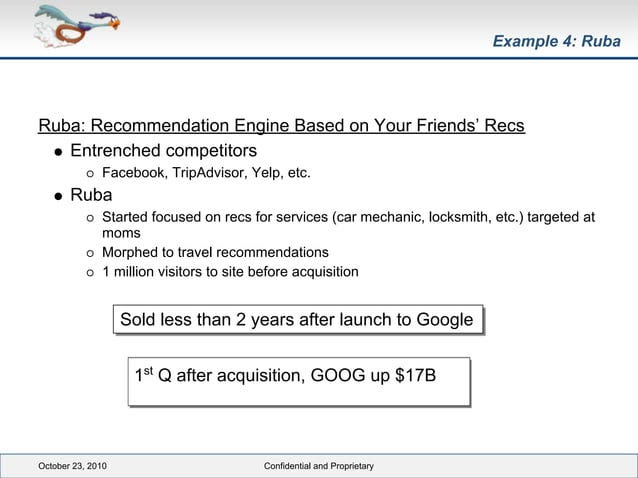
My fourth company, Ruba, was based on recommendations from your friends. Again, the first idea didn’t catch on. We turned it into a travel site, and that’s when we sold it to Google.
Speeding up every part of a startup
How do you speed up every part of a startup? That includes fundraising, opening an office, hiring, getting new employees started, product development, business development, marketing and PR, and changing direction. Let’s go through each one.
Fundraising
Speed and capital
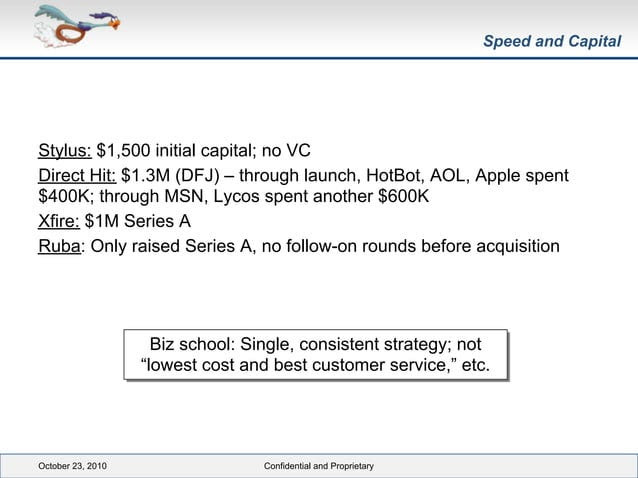
Not much money went into the companies I built, which should be encouraging. You don’t have to raise $10 million as your first step.
Stylus started with $1,500. Direct Hit’s Series A was only $1.3 million. I pitched DFJ at 8:15 in the morning, and they tracked me down to give me a term sheet at 4:30 that afternoon. We hadn’t even spent the full round when we got HotBot, AOL, and Apple as customers; we had spent only $400,000. By the time Microsoft and Lycos also became customers of our search engine, we had spent only another $600,000. Xfire’s Series A was only $1 million.
Business schools teach the value of a single, consistent strategy. If your strategy is speed, it should apply to fundraising too. It’s faster to raise less money than to raise a larger round. Raising less also forces you to move faster: you know you’ll run out of money soon, so you have to act quickly.
Raising venture capital quickly
How do you raise venture capital quickly—potentially closing the same day?
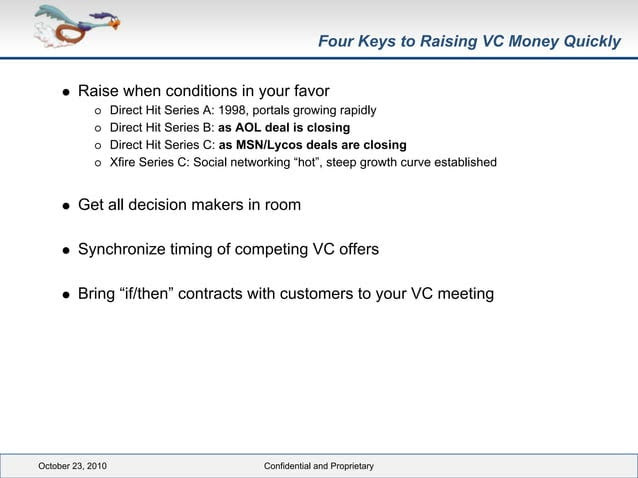
First, raise when conditions are completely in your favor. That doesn’t necessarily mean immediately after a key event; it can mean immediately before one.
For example, as Direct Hit was about to close its AOL deal, under which AOL would use our search engine as part of its results, I approached venture capitalists and said, “I guarantee that my valuation is going up next week when I close the AOL deal, so if you want to come in, now is the time.” We did the same thing when raising money just before closing the Microsoft and Lycos deals.
Second, get all the decision-makers in the room. When I talk to investors, I say, “This is moving very quickly. I’m excited that you’re willing to meet with us, but I need all your decision-makers in the room for that meeting.” Some people will tell you to go jump in a lake. Others will think, “This person must really have something if he has the temerity to ask that.”
It lets you avoid the delays of first meeting an associate, then returning to meet one partner, and then returning again to meet two partners. My advice is to try to get everyone who can make the decision into that first meeting.
Third, synchronize the timing of your offers. I’m very upfront: “I’m meeting one firm at ten, another at one, and another at three. I expect a term sheet at five today.” Again, it’s bold, but it creates the feeling that something is happening.
Finally, bring what I call “if-then contracts” with customers to your VC meeting. With Direct Hit, AltaVista and Infoseek each wrote me a letter that said, in effect, “Mike, if you design a search engine with 50-millisecond response times and 80 percent of our users think its results are better than our current results, we’ll use it and pay you $1 per thousand results.”
Companies aren’t too worried about signing a letter like that. It may not even be legally binding, and they don’t necessarily believe you’ll achieve what you’ve promised. But when you walk into a venture capitalist’s office with that letter, you’ve eliminated half of what the investor worries about: whether you can sell and whether customers will want the product. Now you can say, “Yes, I have customers.”
The other concern is whether you can build it. Before approaching venture capitalists, we brought together an excellent database designer and created a Gantt chart for Direct Hit. Development would take 12 weeks; three people would work on it; and these were the tasks. The VCs had no idea whether the chart was right, but it showed that we had thought through the technical risk.
You can do these things before meeting a venture capitalist. They show that you’re focused on both the customer and how you’ll build the product.
Opening an office
I’m proud of the nuts and bolts of execution.
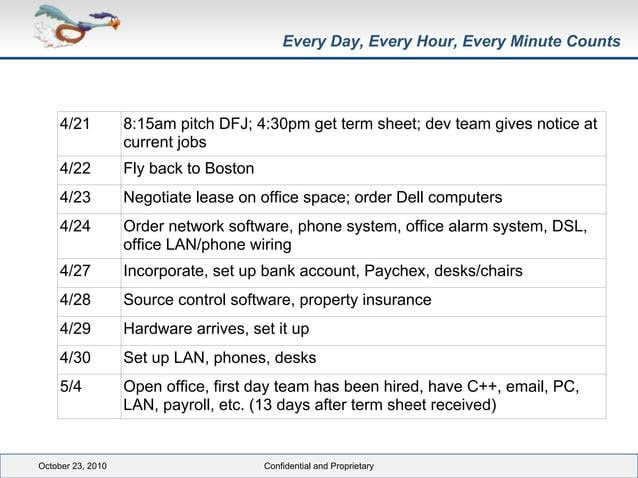
The morning we raised Direct Hit’s first round, I called the developers in Boston before I even got on the plane to fly back and said, “Quit your jobs. We’re going to start.”
The next day, I was negotiating an office lease and ordering computers. Then came the network software, phone and alarm systems, incorporation, bank account, payroll, insurance, furniture, source control, email, and everything else. You have to be excellent at executing all of these details so that, less than two weeks later, you can open an office with everything ready. You hit every task with speed.
Hiring
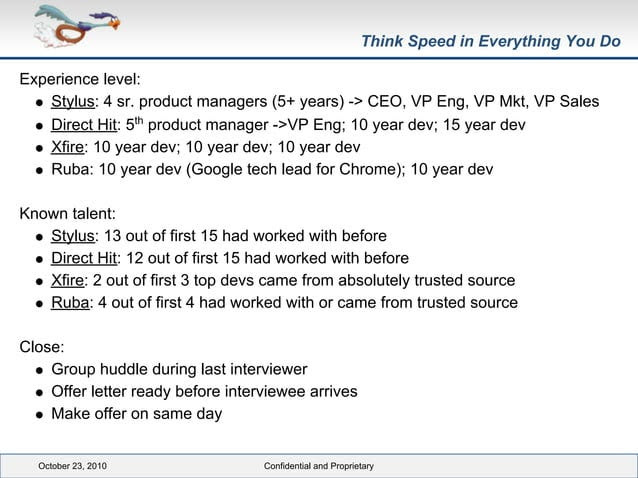
First, consider the people I’ve hired. Many of them had a lot of experience. I love the energy and enthusiasm of people right out of school, but in my experience, a developer with five or seven years of work behind them can be so much faster.
Several of these companies were built with only three developers. The core products at Xfire and Direct Hit were built by teams of three. I talk about 20-times or 30-times developers. To me, that literally means one developer who can do in a day what another developer would take 20 days to do. You can find those people.
Look for experienced people and, when possible, people you’ve worked with before. At Stylus, I had previously worked with 13 of the 15 people we hired. At Direct Hit, it was 12 out of 15.
How do we hire quickly? I like to conduct every interview on the same day. A candidate may have five or six interviews beginning around noon. As the interviews happen, if people are saying, “Yes, this person is good,” I’ll conduct a real-time reference check at three in the afternoon. My friends are used to this now: “Oh, this is another reference check where you need an answer within half an hour?” Yes, it is.
Never limit yourself to the references candidates give you. Find out where they have worked, then use your network to locate someone from that company who can speak about them.
At the end of the day, before the candidate leaves, hand them an offer letter and say, “We’re really excited. We’re giving you an offer. Are you ready to join?”
They’ll say, “Whoa, I didn’t expect this. I need to think about it.”
You say, “Great. I don’t want to rush you. Can you call me at nine tomorrow morning and let me know?”
That kind of intensity helps you avoid bidding wars and keeps the candidate from getting cold feet after thinking about the decision for too long. It also sets the pace. When people join your company, they already expect it to move this quickly.
Getting new employees started
It’s a cardinal sin to have someone arrive excited for the first day only to tell them, “The computer isn’t quite set up. Your email account isn’t ready. We forgot to order the source-control license, so read these manuals for now.”
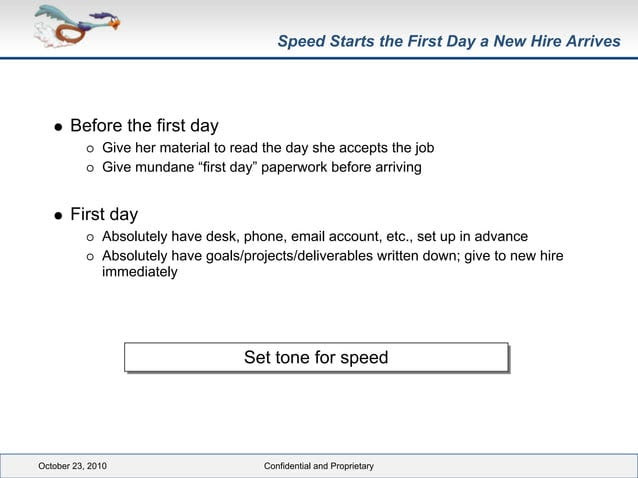
Before people arrive, have them complete their W-2 paperwork and other administrative work. Don’t use their first day for that.
When they arrive, every piece of hardware and software should be ready. Their task list should also be prepared: here’s the task, and here’s the project. It’s efficient, but just as importantly, it sets the tone, pace, and intensity. When someone walks into that environment, they think, “All right, this is for real.”
Product development
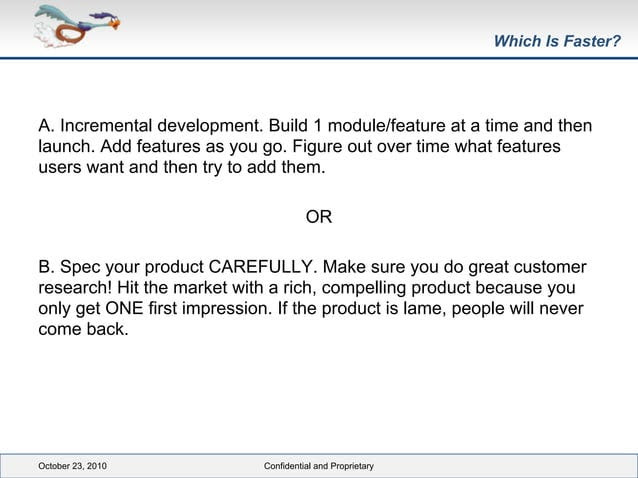
Let’s make this interactive, because there’s a genuinely difficult choice.
Option A is incremental development. Build one feature, launch it, add another module later, and continue adding features as you listen to the market.
Option B is to spec the product carefully and conduct strong customer research. You don’t want to design in a vacuum, and you want the first version to be very good because you get only one first impression. If someone tries your product and dislikes it, they may never return.
How many people think Option A is the faster approach? How many think Option B?
I’ve always chosen Option A. Both arguments are compelling, but the first version of every product I’ve launched has been extremely simple.
The first version of our computer-telephony product handled only two analog telephone lines. That was all it did. Eventually, it became a digital system that handled 64 simultaneous lines, fax, automated attendants, and many other features.
Direct Hit was the same. The first version did nothing but count clicks: this site had been clicked 17 times, and that one 46 times. It didn’t measure whether someone stayed for three seconds or five minutes. It didn’t account for a search such as “U.S. Open” meaning tennis or golf at different times of year. We added those features as we went.
Incremental development simplifies the development effort and the marketing effort. I think it’s a much faster way to launch.
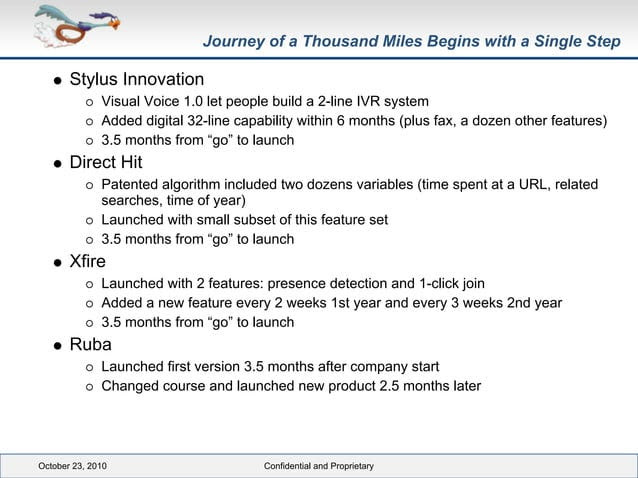
These examples show the same pattern. Stylus launched with two-line interactive voice response and added more features later. Direct Hit launched with a small subset of its eventual feature set. Xfire launched with just two features—presence detection and one-click joining—then added a new feature every two weeks in its first year and every three weeks in its second. Ruba launched one version 3.5 months after the company started, changed course, and launched a new product 2.5 months later. A journey of a thousand miles begins with a single step.
Business development
How can you close business-development deals quickly?
I have a number of little sayings in my companies. One is, “The chance of anything good happening is never greater than 50 percent,” which really annoys people. Another is, “What can go wrong?” When developers come into my office and say, “It’s going to work perfectly,” I ask, “What can go wrong?”
For business development, the saying is, “The probability of any deal ever closing declines by 10 percent for every day it doesn’t close.” I really believe that.
It changes your behavior. If you start a negotiation that you expect to take two, three, four, five, or six weeks, say, “If we don’t close this today or tomorrow, I don’t think it’s going to close.” Be bolder.
At first I was scared that pushing too hard and losing a deal would be a mistake. Over time, though, I realized that everyone is so busy that they may have only two or three things at the top of the list that can get done on a given day. If you aren’t on that list today, you won’t get done. You’ll be number seven tomorrow, and number seven again the day after that.
So I push to close deals. Direct Hit’s Microsoft deal—under which we provided results at the top of Microsoft’s search-results list—was done in 10 days. The AOL deal took about two weeks. The deals that took longer, with Infoseek and AltaVista, stretched on for months and never closed.
Limited supply also works. “We’ve sold the sponsorships for July, August, and October. September is still available, but someone else wants it.” It’s an old trick, but it works. A deadline and limited supply get people to act. If certain regions on a map have already been taken, people become anxious that they’ll lose out.
The biggest motivator is fear of competitors. Talk about what their competitors are doing. I’m very open: “Yes, of course I’m talking to your competitors.” I don’t reveal confidences, but I’ll say, “I want to warn you: if you see an announcement that we’re partnering with one of your competitors, don’t say I didn’t warn you.” That drives them crazy.
Marketing and PR
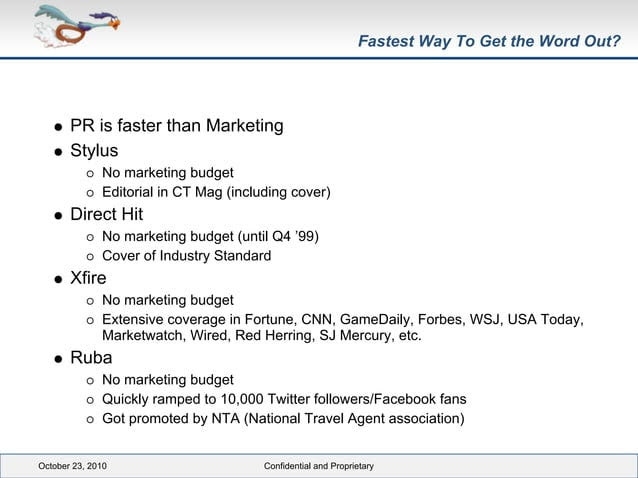
There’s a tension between PR and marketing, and I’m going to annoy people who are big fans of marketing: PR has worked much faster for me.
Marketing has delays. There’s a delay while you decide what the ideas are and another delay while you create and produce the materials.
Stylus had no marketing budget. Our strategy was to get editorial coverage in Computer Telephony magazine, and I think we were on its cover three times in our first year. Direct Hit had no marketing budget either, and we were on the cover of The Industry Standard. Xfire also had no marketing budget; it received enormous press coverage.
I used to wish the Force from Star Wars were real. I wanted to use it to make someone sign a purchase order or make an investor give me a million dollars. Then I realized that a version of it is real. If you become persuasive—if you develop charisma or whatever you want to call it—you can make things happen.
You can do that with the press, too. Reporters love dealing with the actual entrepreneur. All day long, they hear pitches from PR people; that’s the PR person’s job. It’s much harder for a reporter to believe a PR representative saying, “This is the greatest product I’ve ever seen,” than to believe the entrepreneur. I’ve always tried to handle those conversations directly.
Changing direction
As I mentioned, the original product didn’t work at three of my four companies. I hope that encourages anyone working on something that isn’t quite working. I’ve been there.
Once you decide something isn’t working, you have to change direction decisively. It’s sad to watch companies enter a death spiral: it’s not working, it’s not working, it’s not working, and then they crater without changing.
Other companies change tentatively: “We’ve worked on this for a year and have two customers. I’m not sure it’s working, so let’s put 15 percent of the company on a new idea as an experiment.”
I think that’s wrong. Once you know something isn’t working, move the entire company immediately.
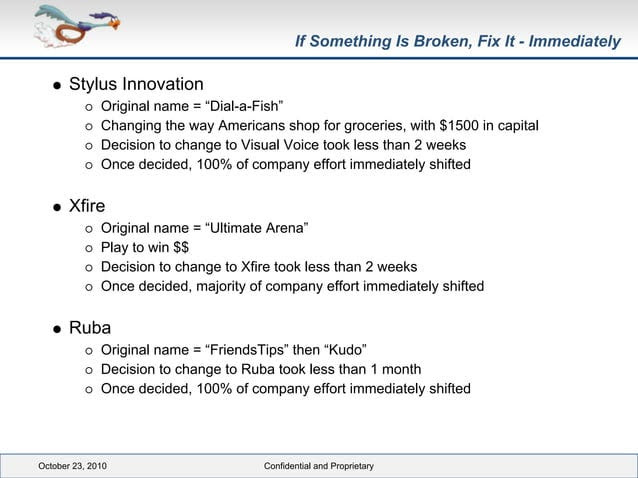
At Stylus, the decision to switch from Dial-a-Fish to Visual Voice took less than two weeks, and the entire company moved to Visual Voice.
Xfire didn’t begin as an instant messenger for PC video gamers. It started as Ultimate Arena, a site where people would play online tournaments, put in a dollar, and try to win money from other players. Once we decided to change direction, it took two weeks. We shifted the majority of the company immediately.
The same was true of Ruba. Look at how many names we went through: FriendsTips, then Kudo, then Ruba. When we changed direction, 100 percent of the company moved.
Direct Hit: $500 million in 500 days
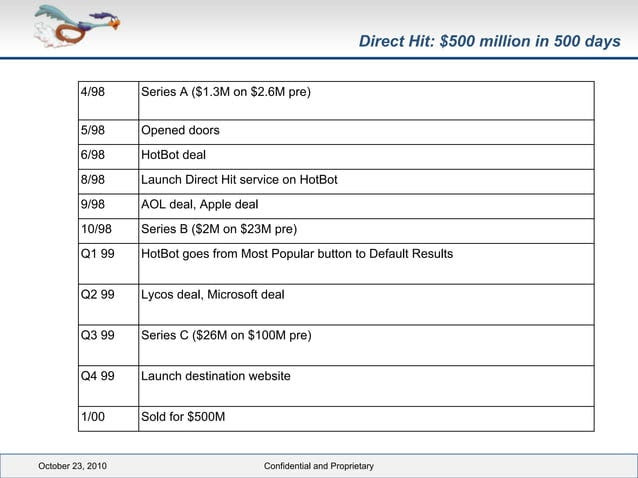
This final example is aspirational. People who are into finance will love the multiples.
Direct Hit raised a $1.3 million Series A on a $2.6 million pre-money valuation, and we opened our doors less than two weeks later. A month after that, we signed a deal with HotBot, then the fourth-biggest search engine. There was no way our product could have been finished, but we got a real, signed contract in which HotBot agreed to use it and pay us.
Two months later, the product was done and we launched with HotBot. Once we had HotBot as a customer, we were able to get AOL and Apple. As we were closing the AOL deal, we raised a $2 million Series B on a $23 million pre-money valuation.
Our link at the top of HotBot’s search-results page then became HotBot’s default results. We got the Lycos and Microsoft deals, and again used the timing of those closings to raise money: $26 million on a $100 million pre-money valuation.
Then we launched a destination website. Five hundred days after launch, we sold the company for $500 million.
Q&A
Mike Cassidy: Are there questions? Go ahead.
Audience member: On fundraising: first, if your valuation is going up next week because you have those deals closing, why not wait and get a better deal from the VCs? Second, with such short development cycles and so little money required, why raise money at all?
Mike Cassidy: Why do I leave money on the table? I do it all the time because I don’t believe in winning a negotiation. I have a saying: I want everyone who has invested in me, everyone who has worked at one of my companies, and everyone with whom I’ve made a business-development deal to want to do another deal with me. So I always leave money on the table.
I’ll also give up money for speed anytime. If someone is willing to give me $1.3 million on a $2.6 million pre-money valuation today, I’ll take that over the possibility of getting $2 million on a $4 million or $5 million pre-money valuation next week. I place an enormous discount on the value of time, so the speed is worth it to me.
The second question is: why raise money at all? I’ve had very good relationships with my investors, and it isn’t just about the money. I didn’t really need to raise money for my second, third, or fourth company; I could have self-funded them with the money I had already made.
But my investors did a couple of things for me. First, they challenged me. During monthly board meetings they would ask, “Why are you doing it that way? This person does it another way.” Even when examining the original idea, they would say, “Make sure that’s really what you want to do.”
Second, I’m a big believer in the power of networks and connections, as many people in this room probably are. The introductions my investors made have been invaluable. DFJ introduced me to AOL, which led to that deal. Benchmark was unbelievable: “You want to talk to the CEO of Verizon? Sure, tomorrow.”
Other questions?
Audience member: You’re optimizing your situation and your investors’ situation, but how do the companies that buy your companies do afterward? If they struggle, doesn’t that poison the opportunity the next time around?
Mike Cassidy: No. Put it this way—
Audience member: Because I’ve gone in behind companies that were struggling.
Mike Cassidy: Sure. I’m well aware of the problem. Here’s one data point: in the first quarter after Google bought us, its market capitalization went up $17 billion—which I take full responsibility for.
When Artisoft bought Stylus, it eventually closed all its other product lines, and ours became the only product it sold. That was great validation that we weren’t just junk.
Direct Hit was bought by Ask Jeeves, and that one is trickier. The timing was difficult because the acquisition happened just as the bubble was bursting in the spring of 2000. I think most people agree that the technology we brought was very valuable to Ask Jeeves. The jury is still out on how successful that acquisition was.
When MTV bought Xfire, we had three million users. About two years later, it had 15 million. From a user-growth perspective, that was pretty good. But—go ahead.
Audience member: If I were buying one of your companies, I would want you.
Mike Cassidy: Well—
Audience member: I would want to keep you, because you’re the creative genius. Many companies struggle when that creative genius leaves.
Mike Cassidy: Google is doing a really good job of treating me well so far. We’ll see. Other questions?
Audience member: Did you use bankers when you sold your companies? In general, did you proactively seek a sale, or did buyers solicit you and you simply accepted?
Mike Cassidy: Great question. In general, I don’t believe you can sell your company. Companies buy companies, but it’s almost impossible to knock on a door and say, “Buy me, buy me, buy me.” The fact that you’re knocking on the door asking to be bought is a big red flag that something must be wrong.
You can introduce yourself to companies by pursuing strategic partnerships, then let them conclude that they want to buy you. But no, I never called a company and said, “Buy me.”